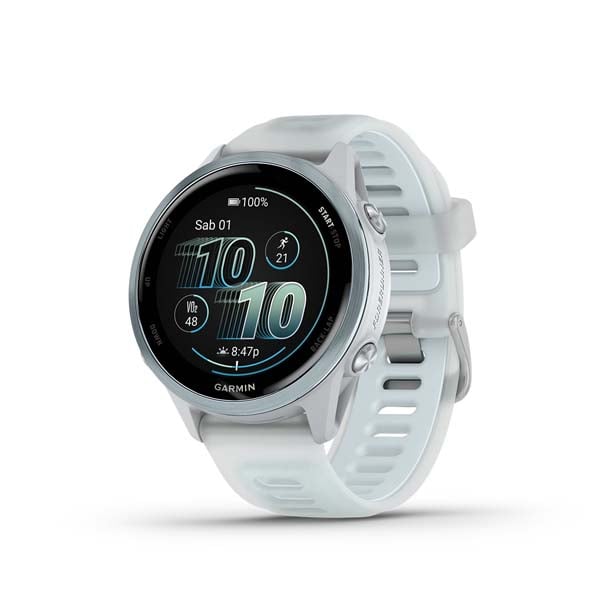
Garmin Forerunner 570 review: the deal matters more than the spec sheet
The Garmin Forerunner 570 is one of those running watches that makes far more sense at a discount than it does at full retail. At its launch price of $549 / £459, it sits awkwardly close to more feature-packed sports watches. At roughly €320, though, the story changes: you get Garmin’s excellent training tools, bright AMOLED display, accurate dual-band GPS, and enough battery life for everyday wear without stepping up to the bulkier Forerunner 970.
This Garmin Forerunner 570 review is aimed at runners who train a few times per week, want reliable health tracking, and plan to wear the watch all day. If your priority is offline maps, ECG, or multi-day ultra events, this is not the most complete watch Garmin sells. If you want a lightweight daily running watch with premium Garmin polish, it can be a very smart buy when the price drops.
What changed from the Forerunner 265
The Forerunner 570 is effectively the successor to the Forerunner 265, but Garmin moved the naming and the price upward. The big upgrades are a brighter AMOLED touchscreen, a newer Elevate Gen 5 optical heart-rate sensor, two case sizes, an aluminum bezel, added sport profiles, and a built-in speaker and microphone for Bluetooth calls and voice controls when connected to your phone.
The two sizes are important. The smaller 42 mm version is the one to look at if the Forerunner 970 feels too large or heavy, while the 47 mm model gives you a larger 1.4-inch display and slightly longer quoted smartwatch battery life. Both keep Garmin’s five-button layout, which still matters during sweaty runs, rainy weather, and winter training gloves.
Display, comfort, and daily wear
The display is one of the strongest reasons to choose the Forerunner 570. Reviewers consistently found it bright and easy to read outdoors, and Garmin’s AMOLED interface feels sharper and more modern than older memory-in-pixel Forerunners. It is not just a running tool; it works nicely as a daily smartwatch for notifications, timers, calendar glances, Garmin Pay, sleep tracking, HRV status, and music controls.
Comfort is also a win. The 42 mm version weighs about 42 g, while the larger version is still light for a serious training watch. The polymer case keeps it from feeling dense, and the 5 ATM water resistance means pool swims and wet-weather runs are normal use, not special occasions.
Running and training performance
For actual running, the Forerunner 570 is very strong. It includes dual-band GPS, Garmin’s daily suggested workouts, race predictions, VO2 max, Training Readiness, HRV status, recovery guidance, multisport support, and enough activity profiles for most runners, cyclists, swimmers, and casual triathletes. The newer heart-rate sensor is a useful upgrade over the older Forerunner 265 sensor, especially for harder workouts where wrist-based optical sensors can struggle.
That said, serious athletes should still consider a chest strap for intervals, tempo runs, and race-day pacing. Wrist heart rate has improved a lot, but a dedicated strap remains the safer choice when precise heart-rate zones matter. The good news is that the Forerunner 570 supports external Bluetooth and ANT+ sensors, so it can grow with your training.
Battery life: good, but not class-leading
Battery life is good enough for most runners, but it is one of the reasons the full price feels high. Garmin rates the Forerunner 570 at up to 10 days in smartwatch mode for the 42 mm model and up to 11 days for the 47 mm model. GPS-only tracking is rated up to 18 hours, while the most accurate multi-band modes reduce that figure. With the always-on display enabled, real-world use can land closer to three to five days depending on notifications, workouts, brightness, and sleep tracking.
For someone running two or three times per week and wearing the watch 24/7, that is perfectly manageable. You will probably charge it once or twice a week if you like always-on display, and less often if you use raise-to-wake. Marathoners and most triathletes are covered. Ultra runners, hikers who want long navigation days, and people who hate proprietary charging cables should compare it carefully against the Forerunner 970, Enduro line, or other long-battery GPS watches.
The missing features that matter
The biggest omission is full offline mapping. The Forerunner 570 supports breadcrumb-style routing and point-to-point navigation, but it does not give you the richer color maps found on the Forerunner 970 and several outdoor-focused competitors. That is fine for road running, familiar routes, and most structured training plans. It is less ideal for trail runners who explore new areas and want map context directly on the watch.
It also lacks ECG support, despite using Garmin’s newer Gen 5 optical sensor platform. Some buyers will not care, but it is a fair criticism at the original asking price because many cheaper mainstream smartwatches include ECG. The speaker and microphone are useful for occasional calls and voice commands, but they do not transform it into an Apple Watch replacement.
Is the Garmin Forerunner 570 worth it at €320?
At roughly €320 for a new, warrantied unit, the Forerunner 570 is easy to recommend for runners who want the smaller 42 mm case, Garmin’s training ecosystem, and a bright AMOLED screen. That price puts it much closer to discounted Forerunner 265 territory while giving you the newer design, voice features, updated sensor, and broader sport profile list.
At full MSRP, I would be more cautious. The Forerunner 265 can still be excellent if found heavily discounted, the Forerunner 970 adds maps and higher-end features, and the Venu line may suit people who care more about smartwatch features than structured running metrics. But for a runner doing a couple of sessions per week, wearing it all day, and wanting something smaller than the 970, the 570 becomes a strong value once the price drops below the usual midrange ceiling.
Our verdict
The Garmin Forerunner 570 is not the unbeatable midrange watch its price suggests, but it is a polished, lightweight, genuinely useful running watch. Buy it if you find a real discount, want the 42 mm size, and care most about Garmin training tools, GPS accuracy, and daily comfort. Skip it if full maps, ECG, or maximum battery life are non-negotiable.