Why a 2,000 sq ft humidity problem is different
Choosing an energy-efficient dehumidifier for a large living area is not as simple as buying the biggest number on the box. A 2,000 sq ft open floor plan, an older air conditioner, and humid summer air can overwhelm a small unit quickly, but oversized marketing claims can be misleading too.
The smarter move is to buy for the dampest zone first: the living room, basement edge, laundry area, or hallway where humidity lingers after the AC shuts off. A good 50-pint dehumidifier can pull a lot of water out of the air, but it will still add some heat because it is using a refrigeration system. Energy efficiency, drainage, bucket design, and fan noise matter just as much as raw capacity.
How we evaluated these dehumidifiers
We prioritized current 50-pint and smaller Energy Star-style models with strong owner feedback, practical drainage options, washable filters, and credible testing notes from appliance reviewers. We gave extra weight to units that are easier to live with every day: quieter operation, fewer bucket dumps, automatic restart, and the option to drain through a hose.
One important caveat: if humidity is coming from a leak, poor crawl-space sealing, or water intrusion, no portable dehumidifier is the real fix. It can make the room comfortable, but the source still needs to be addressed.
Top picks for humid homes
1. Midea 50 Pint Cube — Best balance of efficiency and fewer bucket trips
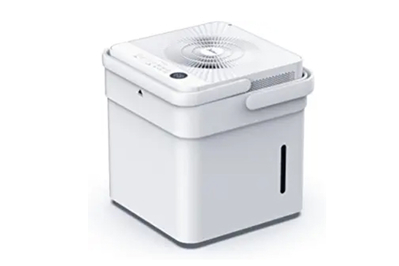
The Midea 50 Pint Cube is the first model I would look at for a large humid living space where energy use and maintenance hassle both matter. Wirecutter highlights it as an Energy Star Most Efficient-rated, Wi-Fi-equipped model, and its unusual cube bucket can hold about 4.25 gallons of water, roughly twice what many standard 50-pint dehumidifiers manage.
That large bucket is the reason it works so well for people who hate emptying a tank every few hours. The tradeoff is weight: the compressor section has to be lifted off to access the bucket, and a full bucket can be heavy. If you can set it up with passive hose drainage into a floor drain or utility sink, it becomes much easier to recommend.
Capacity: 50 pints per day class
Drainage: Large bucket or passive hose drain
Smart features: Wi-Fi app control, 2.4 GHz network required
Typical price: around $275 when available
Best for: large humid rooms, basements, and people who want fewer dumps
2. Frigidaire Gallery FGAC5045W1 — Best smart dehumidifier for remote monitoring
The Frigidaire Gallery FGAC5045W1 makes sense if the unit will live in a corner, storage room, basement, or any spot you do not want to check constantly. Its app support lets you monitor and adjust settings remotely, and reviewers note that alerts and controls are genuinely useful when the machine is out of sight.
Its bucket is smaller than the Midea Cube’s, about 2.1 gallons, but that also makes it easier to remove and carry. It has continuous draining, app control, and compatibility with Alexa and Google Assistant. The main hesitation is long-term reliability: dehumidifiers in general have a mixed history, and Frigidaire models can draw more owner complaints than the Midea Cube. Buy from a retailer with a solid return window if possible.
Capacity: 50 pints per day class
Drainage: Bucket or continuous hose drain
Smart features: App control, Alexa, Google Assistant
Typical price: roughly $350–$400 depending on stock
Best for: smart-home users and out-of-the-way humidity control
3. Frigidaire FGAC5044W1 — Best standard large-room pick
If you want a more conventional large-capacity unit, the Frigidaire FGAC5044W1 is a practical choice. CNET lists it as a 50-pint model with Wi-Fi monitoring, auto shutoff when the tank is full, continuous drain support, and a washable filter. It is not tiny at 12.7 x 15.9 x 24.75 inches and about 43 pounds, but that is normal for a real large-room dehumidifier.
This is the pick I would consider for someone who wants a familiar appliance design instead of the Midea Cube’s lift-off bucket. You still get remote access and hose drainage, and the washable filter keeps maintenance costs down.
Capacity: 50 pints per day
Size: 12.7 x 15.9 x 24.75 inches
Weight: about 43 pounds
Drainage: Manual bucket or hose
Best for: buyers who want a conventional 50-pint unit with smart controls
4. Midea MAD22C1AWS — Best smaller quiet option for bedrooms or spot control
For a full 2,000 sq ft humidity problem, the Midea MAD22C1AWS is not the main answer. But for a bedroom, office, or damp corner where noise matters, it is a strong supporting pick. CNET notes its 22-pint daily capacity, Wi-Fi and voice control, two drainage options, and automatic restart after a power outage.
This is the model to use when you do not need a 50-pint unit running near your couch all evening. It can be quieter and cheaper to operate for smaller zones, especially if the AC handles most of the house but one room still feels sticky.
Capacity: 22 pints per day
Size: 10.51 x 15.31 x 19.8 inches
Weight: about 33.5 pounds
Drainage: Manual bucket or hose
Best for: bedrooms, offices, and quieter spot dehumidifying
What to look for before buying
Capacity: A 50-pint dehumidifier is the safer starting point for a large humid area, but do not expect one unit to evenly fix every room in a 2,000 sq ft house with closed doors. Airflow matters.
Drainage: Continuous hose drainage is the feature that changes daily ownership the most. Buckets are fine for occasional use, but a humid home can fill one quickly.
Heat output: All compressor dehumidifiers add some warmth to the room. An efficient model can reduce waste, but if heat is the biggest concern, run it during cooler parts of the day or place it away from the main seating area.
Noise: Living rooms and bedrooms need lower fan noise. A basement can tolerate more sound, but a TV room usually cannot.
Our verdict
For most large humid homes, the Midea 50 Pint Cube is the strongest first pick because it combines serious moisture removal, strong efficiency credentials, quiet performance, and a bucket design that reduces emptying frequency. Choose the Frigidaire Gallery FGAC5045W1 if remote monitoring matters more than bucket size, or the standard Frigidaire FGAC5044W1 if you prefer a conventional large-room design.
If your goal is lower heat and energy use, do not run a dehumidifier blindly all day. Set a realistic target around 45% to 55% relative humidity, use hose drainage where possible, and let the unit cycle instead of fighting for an unnecessarily dry room.