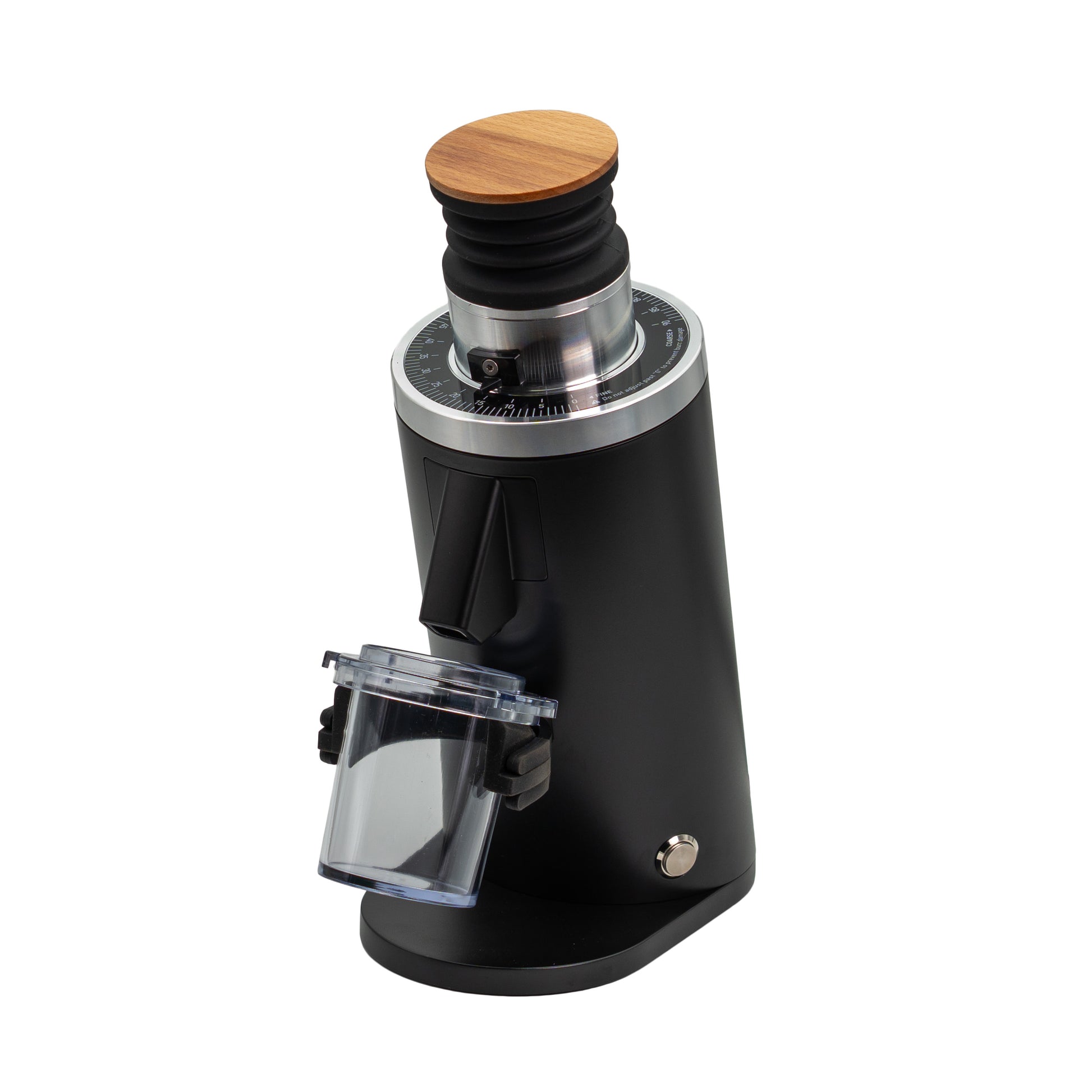
The sub-$300 CAD espresso grinder problem
Finding a real budget espresso grinder in Canada is harder than it looks. Plenty of electric burr grinders sit around $150–$250 CAD, but many of them are built for drip coffee first and only pretend to cover espresso. If you use a bottomless portafilter, that becomes obvious quickly: sprays, fast shots, sour cups, and tiny dial movements that jump from too coarse to choking the machine.
The sweet spot in 2026 is not the cheapest electric grinder. It is the least expensive grinder that gives you fine enough adjustment, decent burr geometry, low retention, and a motor that does not feel like an afterthought. For Canadian buyers trying to stay near $300 CAD, the Turin DF54 is the model I would stretch for first, with the Baratza Encore ESP close behind when it drops to the right sale price.
Our short answer
If your budget is flexible by roughly $30–$50, buy the Turin DF54 / MiiCoffee DF54. Coffee Addicts lists the Turin DF54 V3 at about $329 CAD, while MiiCoffee lists its version around €201.95 before shipping and taxes. The exact landed price changes, but the important part is the grinder itself: 54 mm flat burrs, stepless adjustment, single dosing, a 150 W motor, and claimed retention under 0.1 g.
If you absolutely cannot pass $300 CAD, watch for the Baratza Encore ESP on sale or open-box. Baratza’s official US price is $199.95 USD, but Canadian pricing often lands closer to $299.99 CAD. It is more approachable and easier to service than many no-name grinders, but it is not as refined for single dosing as the DF54.
Why the DF54 is the grinder to beat near this price
The DF54 matters because it brings features that used to be rare in entry-level espresso grinders. Coffee Addicts describes the Turin DF54 as a compact single-dose grinder with custom 54 mm burrs, a 150 W motor, a plasma generator to reduce static, an anti-popcorn lid, and stepless adjustment. It is also small enough for apartment kitchens at roughly 7 inches deep, 4.5 inches wide, and 12 inches tall, with a listed weight around 10 lb.
Those details matter in daily use. Stepless adjustment lets you make tiny espresso corrections instead of jumping between numbered clicks. Low retention means less stale coffee sitting inside the chute between shots. The single-dose workflow is also ideal if you weigh beans before grinding or switch between regular and decaf.
Independent testing is broadly positive, too. The Coffee Chronicler’s DF54 review calls it a disruptive grinder and highlights its sturdy mostly-metal construction, wide grind range, low retention, and surprisingly capable 54 mm burrs for both espresso and filter coffee. The caveats are fair: the dial indicator is not as convenient as it could be, the bellows can look a little cheap, and 54 mm burr upgrade options are more limited than the huge 64 mm ecosystem.
DF54 vs Baratza Encore ESP
The Baratza Encore ESP is still the safer mainstream recommendation for many beginners. Baratza gives it a dual-range adjustment system: settings 1–20 are high-resolution for espresso, while 21–40 are for filter, French press, and cold brew. It uses 40 mm M2 conical steel burrs, grinds at about 1.3 g/sec on setting 10 to 2.2 g/sec on setting 30, and includes a dosing cup with a 54 mm portafilter fit plus a 58 mm adapter.
That is a strong package, especially if you value Baratza’s parts availability and repair-friendly reputation. The downside is that Canadian pricing can erase its budget advantage. If the Encore ESP is $299.99 CAD and the DF54 is around $329 CAD, the DF54 is usually the better espresso-focused buy. If the Encore ESP falls meaningfully below $260 CAD, it becomes much more compelling.
What about cheaper grinders like Shardor, Mokkom, or HiBREW?
Some low-cost flat-burr electric grinders can make espresso-like adjustments, and they may be good enough for pressurized baskets or forgiving medium-dark roasts. The risk is consistency and support. A grinder that looks fine on paper can still be frustrating if the dial has too much play, the burr alignment is poor, static is messy, or the motor bogs down with light roasts.
If you are using a bottomless portafilter, I would be cautious with the $150–$220 CAD tier unless you can verify real espresso performance from owners using non-pressurized baskets. Saving $80 on the grinder can cost more in wasted beans and frustration.
When a hand grinder makes more sense
If $300 CAD is a hard ceiling and you care more about cup quality than speed, a good espresso hand grinder may beat a cheap electric grinder. The trade-off is effort. Grinding for espresso by hand is doable, but it becomes annoying if you pull multiple shots a day or regularly serve two people. For one morning cappuccino, it is realistic. For back-to-back drinks, most people eventually want electric.
Who should buy the DF54
- Best for: beginners with non-pressurized baskets, bottomless portafilters, or machines like the Bambino Plus, Gaggia Classic, or entry-level Lelit models.
- Key specs: 54 mm flat burrs, 150 W motor, stepless adjustment, single-dose workflow.
- Size: about 7 x 4.5 x 12 inches, compact enough for small kitchens.
- Price: roughly $329 CAD at Coffee Addicts at the time checked, with open-box or sale pricing worth watching.
- Main caveat: it slightly exceeds a strict $300 CAD budget, and burr upgrade options are narrower than with 64 mm grinders.
Verdict: stretch a little if you can
For Canadians shopping for a budget espresso grinder, the realistic answer is that the best value often sits just above $300 CAD. The DF54 is the one I would buy if espresso quality is the priority, because its stepless adjustment, low-retention design, and 54 mm flat burrs solve the problems that cheap electric grinders usually create.
The Encore ESP is the fallback pick when it is on a good Canadian sale, especially for buyers who want a simple hopper grinder from a serviceable brand. But if the price gap is only $30 or so, the DF54 is the more convincing long-term espresso grinder.